Ryedale Woodturners
This website is being updated from August 2022. This is an archive page.

Gordon Malan
Thursday 6 June 2019
Snainton Village Hall
Gordon kindly offered to give a demonstration many months ago. A long standing club member and former club chairman, his previous demonstrations have been limited to Hands On nights. He admitted to a little trepidation as the evening had approached.
Square winged bowl
 Gordon has become known in the club and through the AWGB exhibitions for his turned and carved square edge winged bowls. He brought an example of one made from monkey puzzle - with a deliberately different centre, as monkey puzzle has a weak fibrous cente.
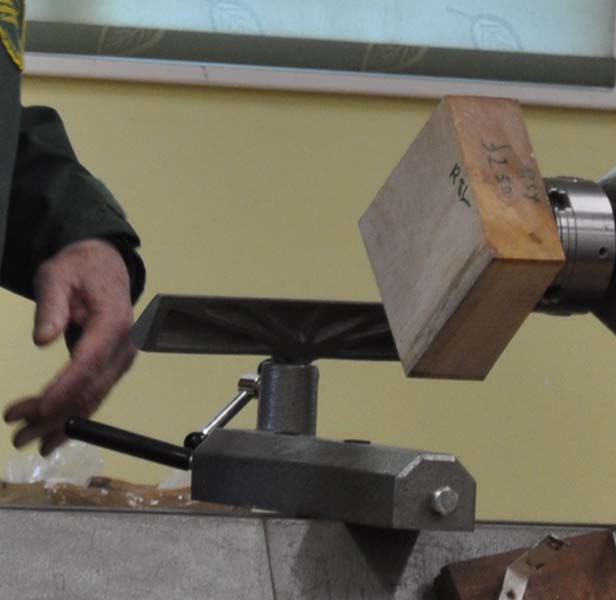
Gordon started with a square sycamore blank, He pointed out that other shapes can be used, such as an oblong. The piece had a few irregularities in it, and unfortunately a deep crack was revealed once the shape was turned. This would probably be discarded in normal circumstances, but the show must go on!

An ogee shape was the target. From experience Gordon felt that better results were achieved by turning from the centre outwards. As always with square edge, care with the corners and with hands and sleeves is essential. A 55 mm spigot was created, with a recess inside, the reason for which would become obvious later.
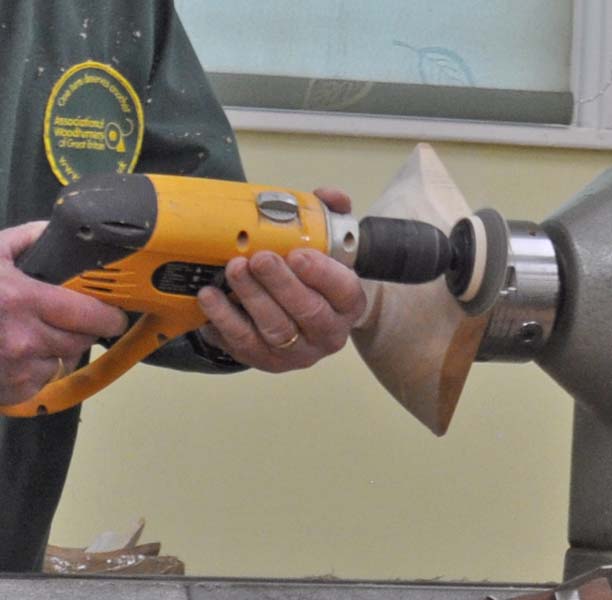
Sanding just to 120 grit was done with a corded drill and a large pad. The central area was sanded whilst revolving, the wings whilst locked and stationary.
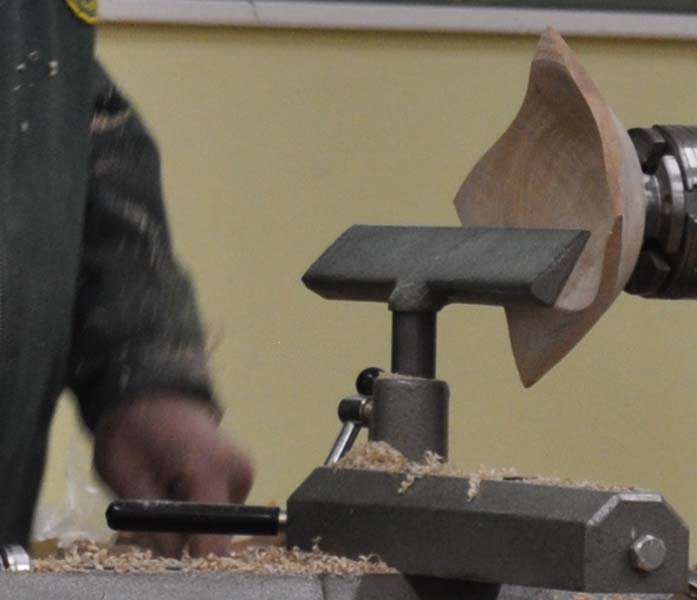
The piece was then reversed and the bowl hollowed out, checking regularly to get an even thickness around the rim on the four sides. A central stub was left while the wings were shaped, to give some stability.
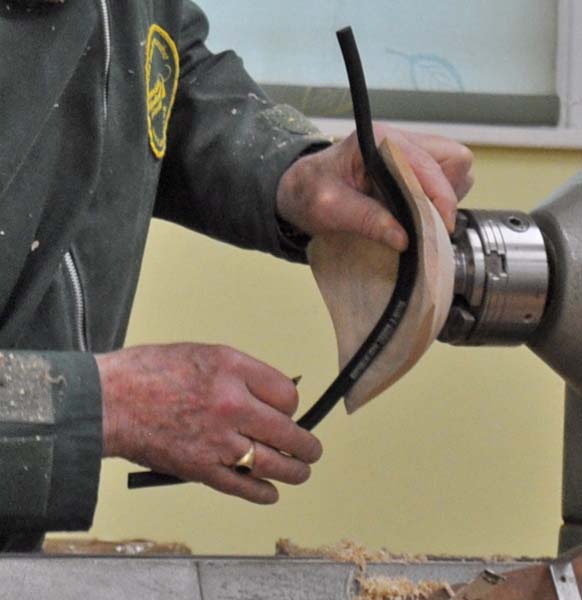
Again the piece was sanded with a 120 grit pad. Lines were then drawn across from corner to corner and edge to edge. A flexible Helix rule was used to follow the contour of the dish. I think 8 lines were drawn in all. These would form the spine of the rays or waves for the finished piece.
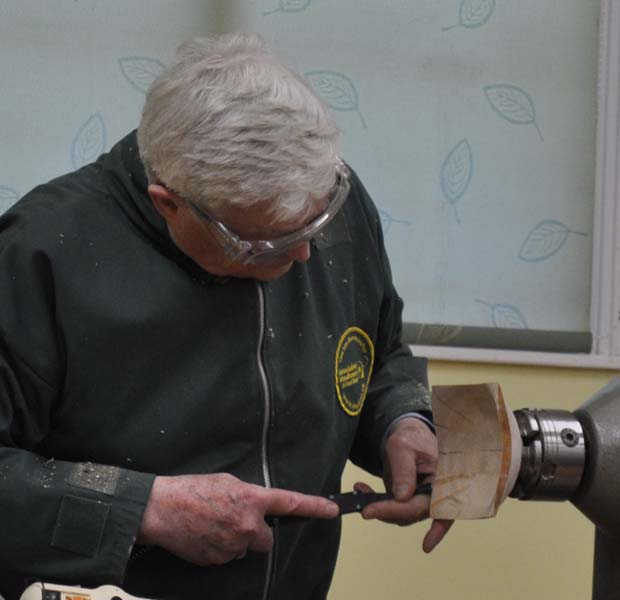
A Flexcut gouge was used to create a hollow between the lines. This could be done with a hand held tool, or the blades can be put in a power carver to speed things up. I think Gordon had an Axminster version with a flexible drive shaft, leaving the weight hanging and a light hand-tool to work with.
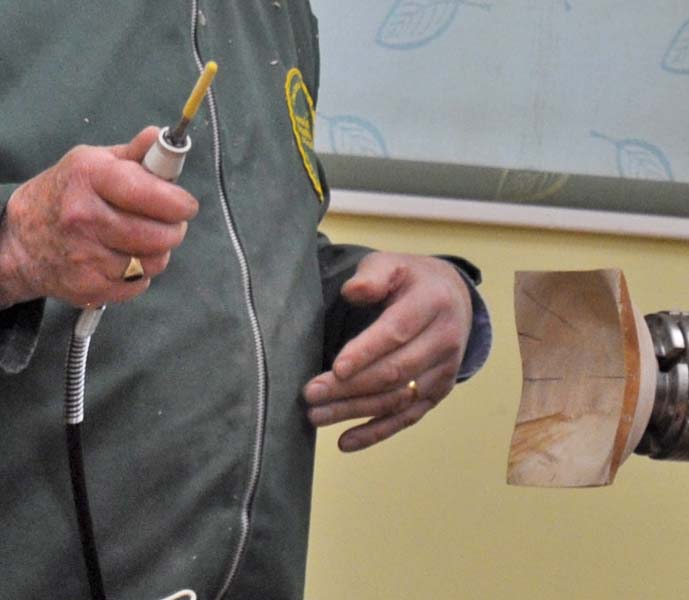
With one hollow gouged out as an example, this was then refined using a powered Saburr tooth rasp, about 2 inches long. The yellow version was used - classed as medium as opposed to green which is coarse.
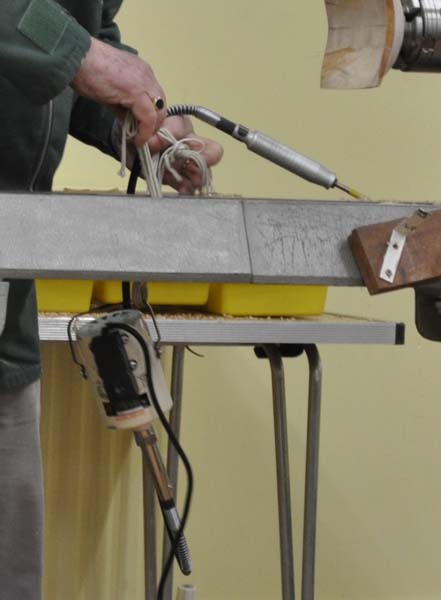 In the workshop the drive unit would hang from a convenient shelf or ceiling hook - here it had to be suspended by a piece of string from the lathe. It was operated by a foot pedal, leaving the hands free to control the tool.
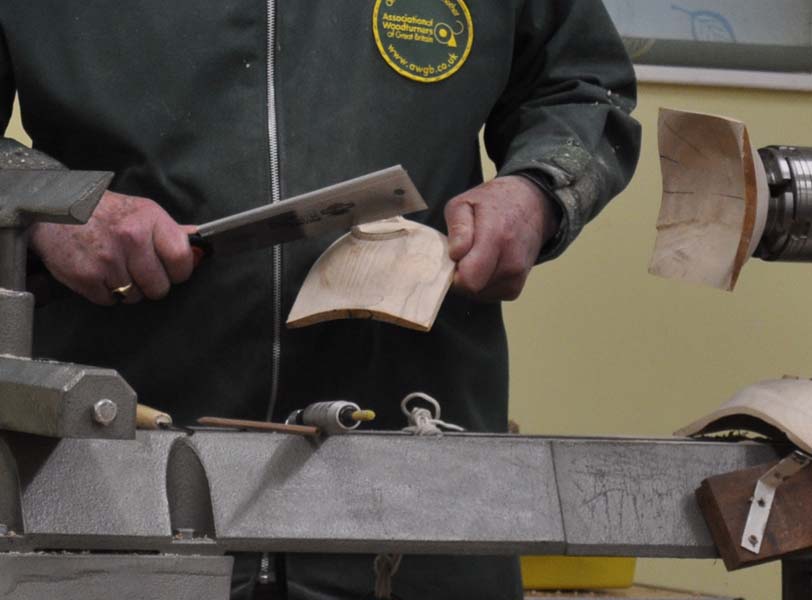
The spigot ring was then cut with a Japanese saw, and shaped with a Flexcut blade to create three small feet. Great excitement and betting was ongoing as to whether there wood be a red stain applied to the wood!
Gordon finished a little early, having shown us the key techniques he uses to create his delicate and distinctive pieces.
During the evening John and Lance updated us on the Goathland exhibition and sale, which had been a successful venture on all accounts, and Bob handed out the small brown envelopes to the fortunate exhibitors.
More examples of Gordon's work
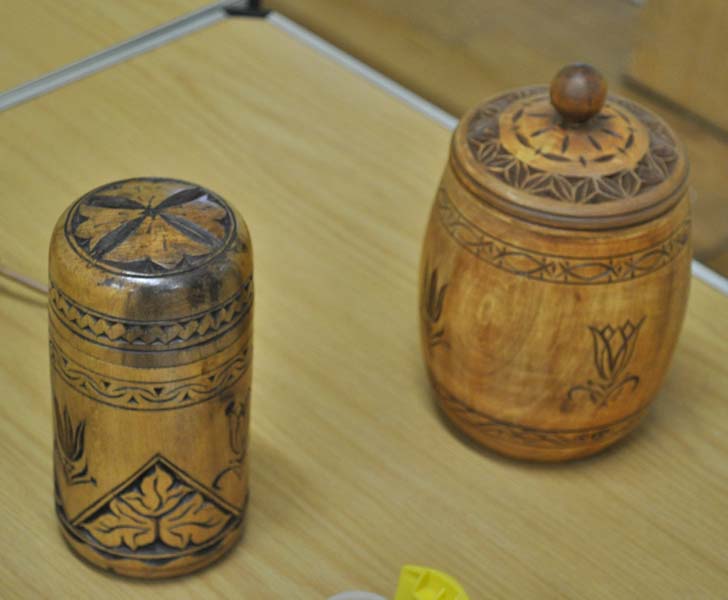
Chip carving by Gordon

Striped edge bowl
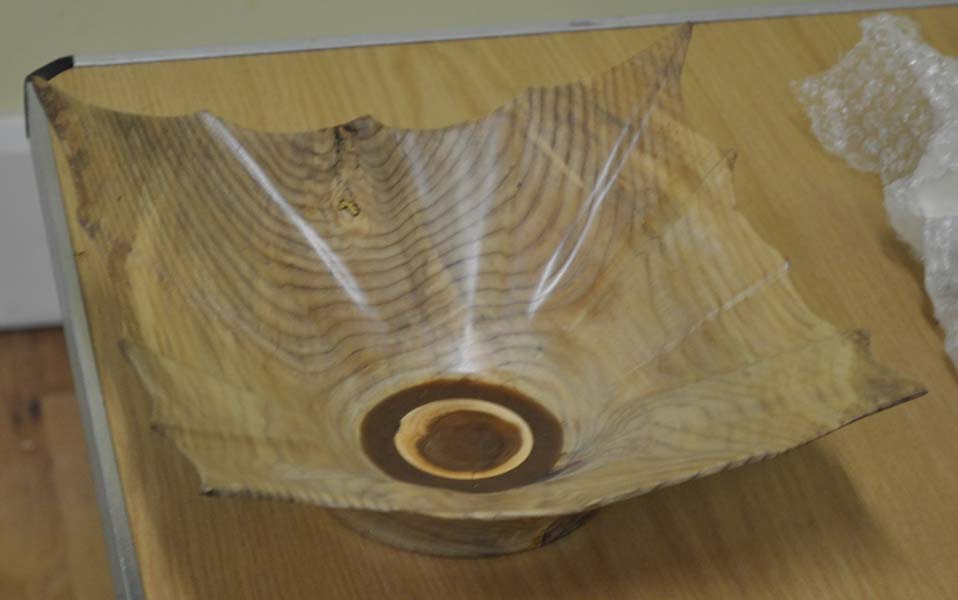
Winged monkey puzzle bowl
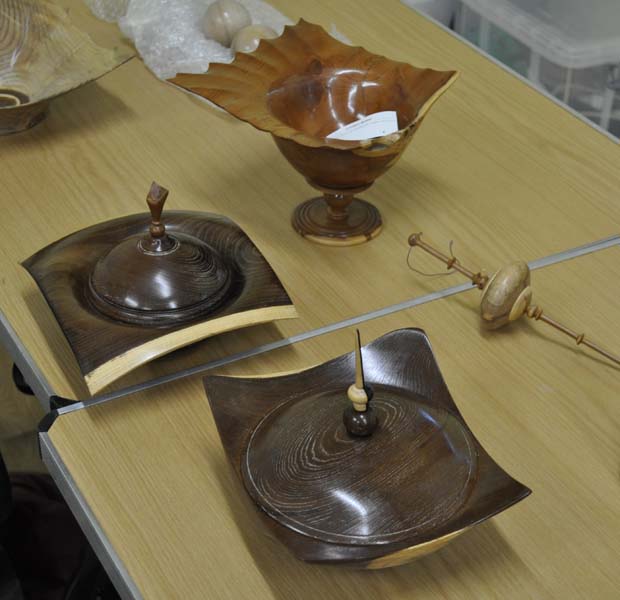
Winged bowls