Ryedale Woodturners
This website is being updated from August 2022. This is an archive page.

Randal Marr
Thursday 3 May 2018
Snainton Village Hall
Randal joined us two months later than originally planned, his event in March having being cancelled due to the heavy snow. He suggested there may be a curse on his visits to Snainton - last time he came he locked his keys in his car, and didn't leave until 1.30am, having waited for the AA to break in to the car and retrieve them.
Triangular cup
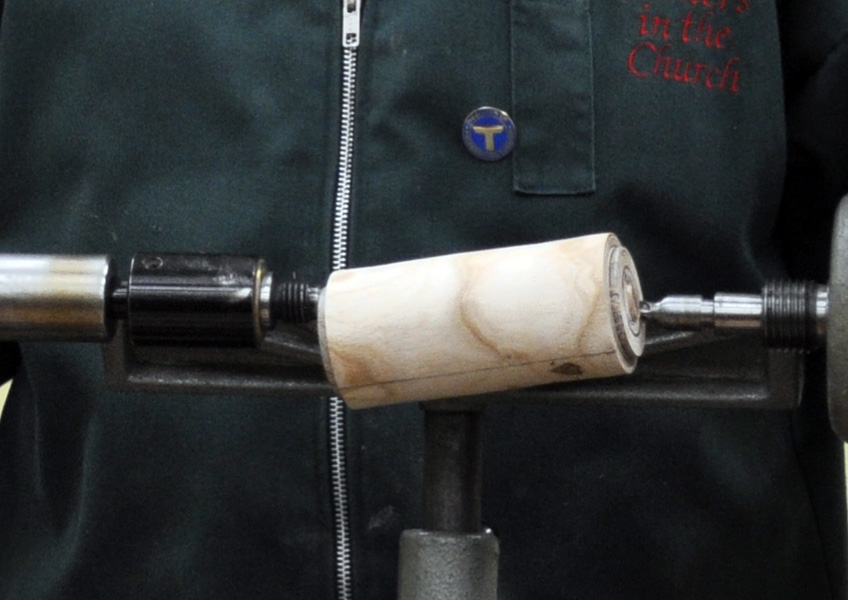
Randal started with a triangular off-centre cup. Three points were marked on each end with a template, numbered 1, 2, 3, then matched in sequence, say 1 to 3, 2 to 1, 3 to 1. It is important to get the sequence correct.


You can check what will be removed by holding a pencil to the block to see what gets marked. The finished result is a cup with a twist - the top dish was turned on true centre.

Turning ply
Randal's second item was a bud vase made from ply, topped with yew and glued onto a pre-shaped base with chucking point. The ply was superglued together, with the lathe being used as a press to fix the pieces.

Turning plywood creates no shavings, just dust. Voids may occur either in turning or in the ply sheets. These can be filled with dust and superglue to good effect. Variations on the idea are shown in the exhibits below.
Branch ball
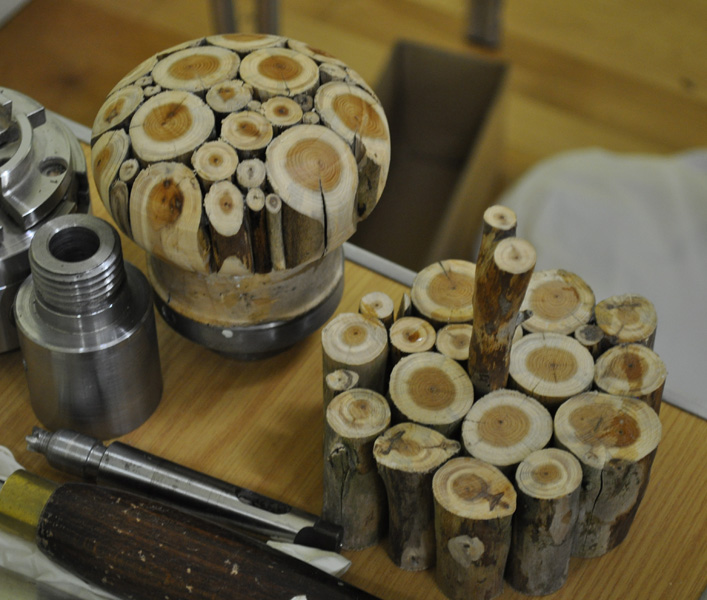
Before the break, Randal described how he makes items out of bundles of branches, usually of yew.
Not a fan of resin, he has tried various ways to fill the voids. Milliput (epoxy putty) works well, but can be an expensive solution.
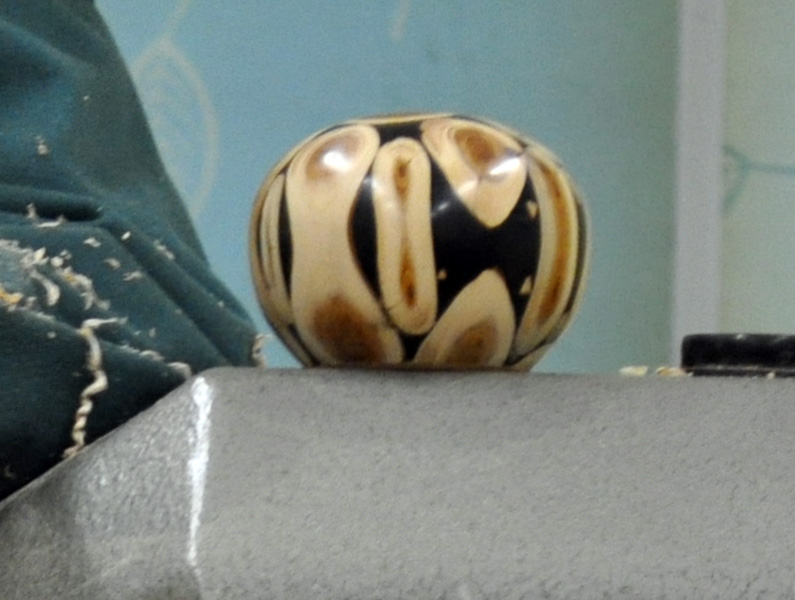
An alternative is to use a cheap car body repair kit for most of the inside of the voids, then Milliput for the exposed parts.
Success in glueing the branches is greatly improved by taking off the bark first.

Randal keeps experimenting with the branch bundles to come up with the best effects, the easiest and most successful ways of fixing them, and the best fillers for the gaps between the branches.
Tipple top
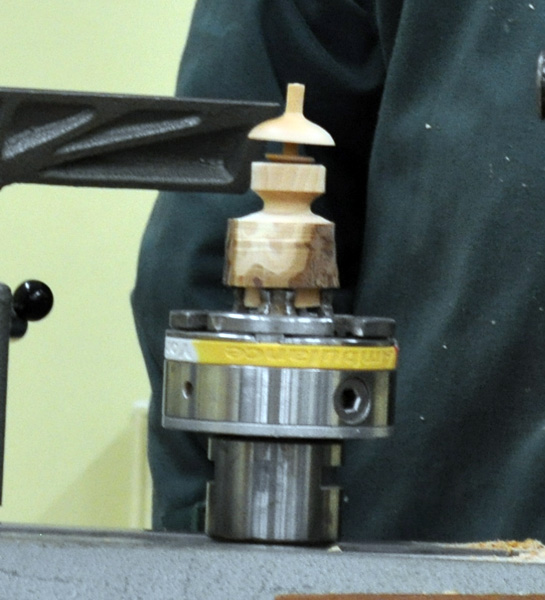
Randal showed us how to make a small spinning top, with the added property that when it stops spinning, it tumbles over but catches on the rim of its base and stays there. He doesn't quite know the formula, but makes a number of tops and a number of bases, then tries them out to find pairs that work.

Randal excelled on the night and produced a top and stand that worked first time - gaining a round of applause.
Note that the top can be tested by taking off the chuck, in case a little fine tuning is needed.

Birds
Next up was a couple of bird forms. A body is turned from any suitable wood. A small dish is turned in the top of the body, which accepts a free standing head - a sphere with a beak. Making a batch of bodies and a batch of heads is standard practice.

A double bird is a variation on this. These have a dish turned at both end, so the body can be reversed for a different effect. This necessitates holding the body once one end is turned, using a home made wooden chuck.
Quick and quirky
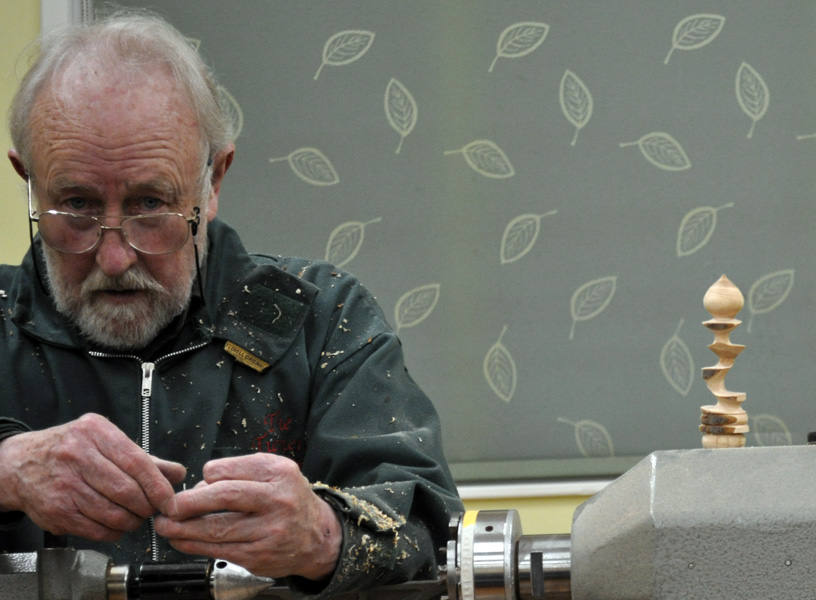
Randal finished with a "quick and quirky" piece - a novelty turned with various off centre orientations.
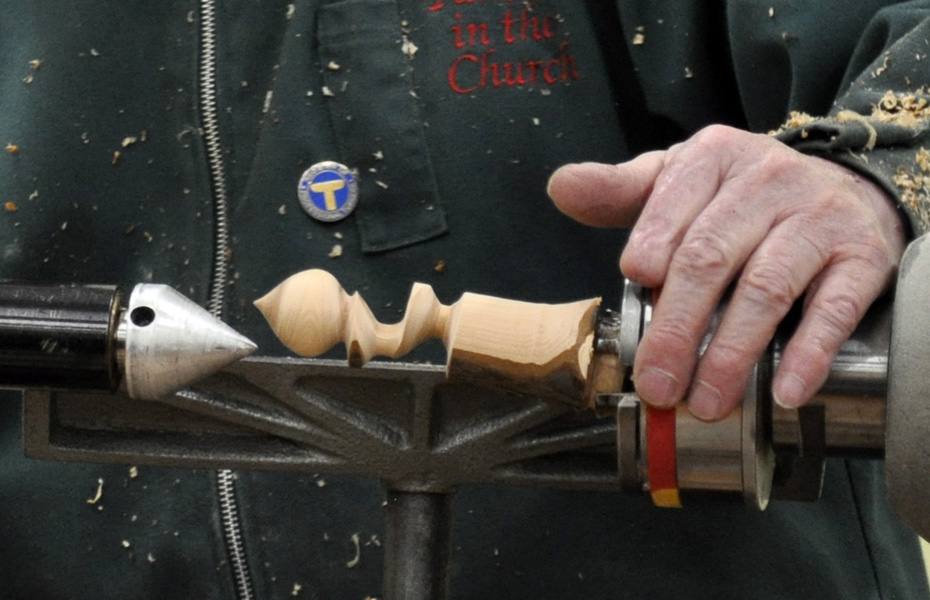
The off-centre positions were achieved by first turning a bead on one end of the blank. This was then used as a spigot, but its being rounded allowed for the piece to be gripped at different angles.
Hints and tips

- Randal uses "Muckle mix" - a finishing mixture made up by David Muckle, to his own secret recipe
- Mushroom tape is a type of Velcro, but with one side adhesive and the other hook and loop. It can be wrapped around a dowel for attaching Rhyno abrasive
- Randal has two wads of abrasive clipped together - 120 180 240 in one wad, and 320, 400, 600 in the other. Easy to use, one after the other, still clipped together.
A few pictures of Randal Marr's exhibits and a couple of members' turnings

Randal Marr exhibits

Perspex sandwiched in ply and turned
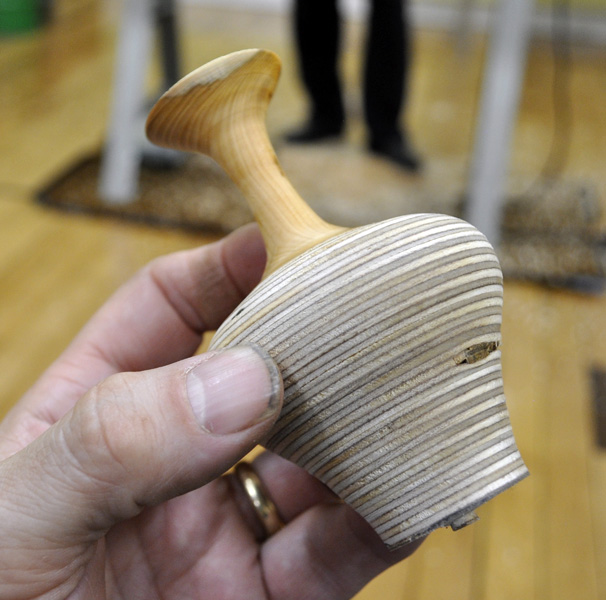
Bud vase turned on the night from stacked plywood
Randal Marr exhibits

Turned plywood pieces

Lamp stand turned from ply


Plywood lampstand
Turned plywood pieces
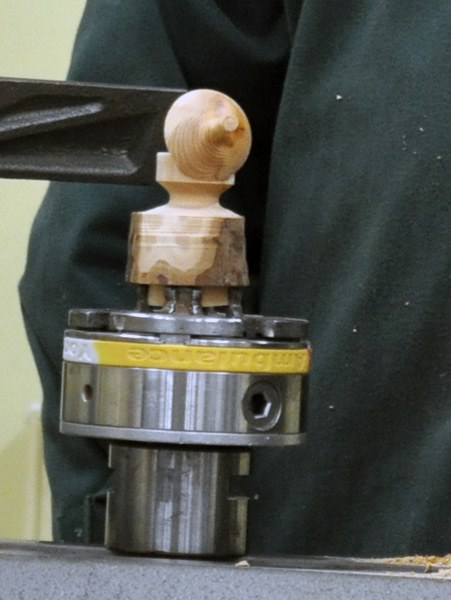
A tipple top

Ryedale Woodturners platter turned and pyrographed by Steve Fearnley

John Whiteley's very large burr bowl