Ryedale Woodturners
This website is being updated from August 2022. This is an archive page.

RANDAL MARR
Thursday 3 November 2016
Snainton Woodworking Supplies
Randal stepped at relatively short notice due to the illness of David Muckle. Randal is RPT, from the same Teeside Woodturners club as David Muckle. He has a good gallery of his work on his Turners in the Church website.
Randall turned four small items using various techniques.
Bottle stopper
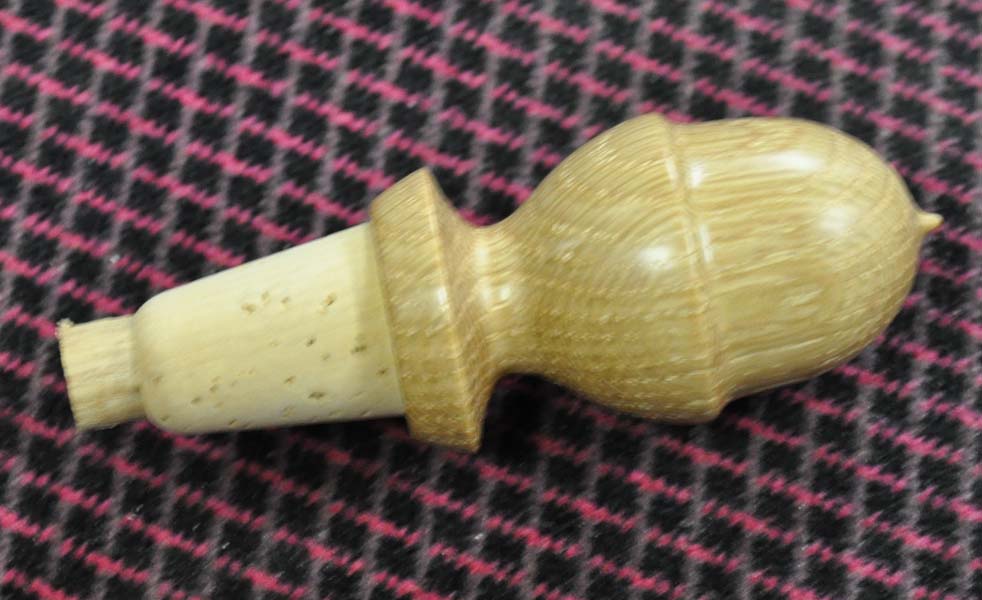
Randal started with a bottle stopper. Turned between centres in the shape of an acorn, from oak of course. The stopper end was turned first, a conical shape to take a cork sleeve, with a little extra to be cut off once finished.

This was held in a Jacob's chuck while the acorn was shaped. Any marking from the jaws would be hidden by the cork sleeve.
The acorn was sanded, then given a light rub with hard wax (made to Randal's own recipe from four waxes) and then buffed to a sheen with a cloth - Randal uses cloth rather than tissue, he has just learnt to hold it loosely and let go if it catches.
Off-centre candlestick
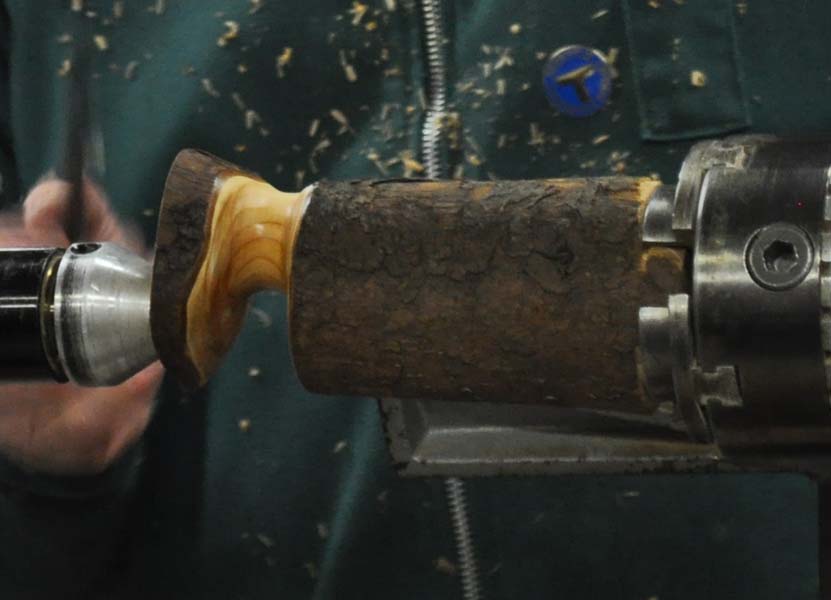
Next up came an off-centre candlestick, turned from a branch of yew, with its bark still on, a couple of inches in diameter. First a bead was turned at one end as a chucking point that would accept a variation in angle of the branch. At the other end a small circle was drawn, and four points marked on this circle.

Some care not to make this circle too large is desirable. The points were numbered 1 to 4. The order in which these centres are used will change the shape of the candlestick.The four centres were used in turn, with sanding sealing and waxing done at each stage.

Given the irregular nature of the piece, Randal had devised sanding sticks which protected his fingers. Basically cones of Rhyno paper fastened on each end of a long dowel, wrapped around wadding made from router mat. Flexible, fitting in to the coves, and safe.
Laminated bird
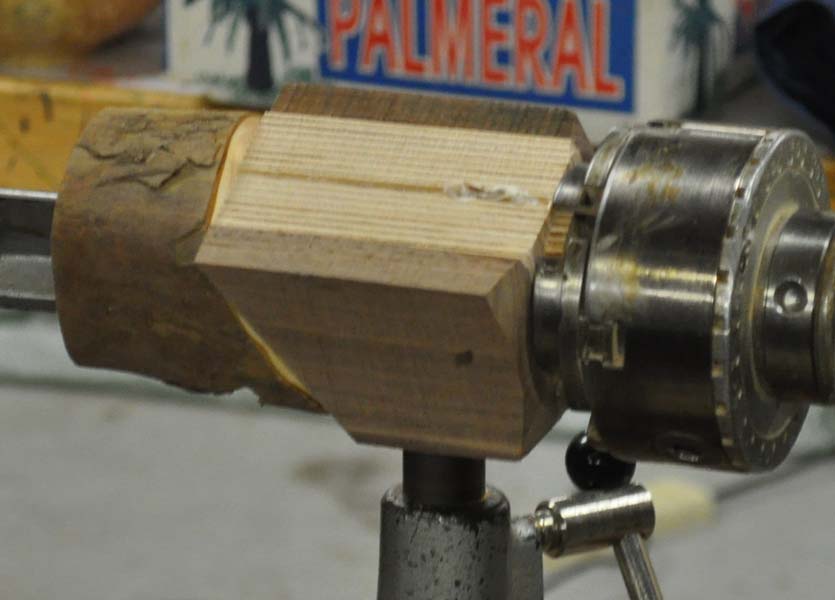
Item number three was made from laminated ply and yew. This sandwich block was turned to produce a bird. No particular special techniques required, though turning plywood can send out sharp slivers, so eye protection is essential. .

The bird took shape quickly, and was ready for its beak and eyes fitting. The bird was sealed and waxed on the lathe as before. Small holes were drilled for fixing, then a drop of glue was put on a sheet of card (not directly on to the wood).

Black beads were picked up with tweezers, dabbed with super glue, and placed in the eye sockets. A small cone was used for the beak, turned in advance. The final effect was a bird with a sriped waistcoat, dark wings and a yew head. Apparently a popular craft fair item.
Christmas decoration

Randal ended the demonstration with a quick production of a small Christmas tree decoration. Turned to shape between centres, a series of grooves were cut. Ideally cut using a thin parting tool, but as Randal could not find his, he used a skew for the job
To finish a small hole was drilled at the end to take a string.

The design had a tulip at the top and a stretched tulip further down. This was planed to a tidy finish using a skew for a planing cut – only the bottom half of the blade must be in contact during this cut.
Hints and tips

Throughout the evening Randal had referenced Boyes as a good source of little extras such as beads and routing mat, and Ikea to a lesser extent. He finished with a tip based on his finding some cheap M33 nuts on the internet, which can be glued to blocks of wood to provide jam chucks or similar, as the nut fits directly on to the headstock drive of his lathe.
Gallery of work
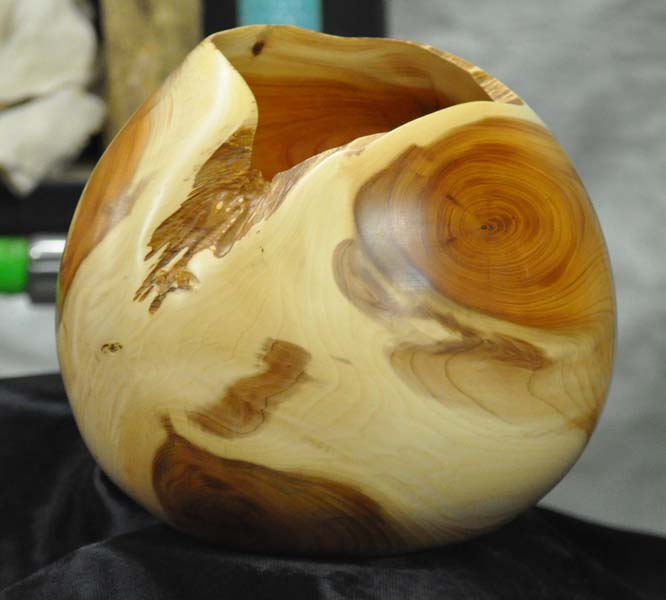
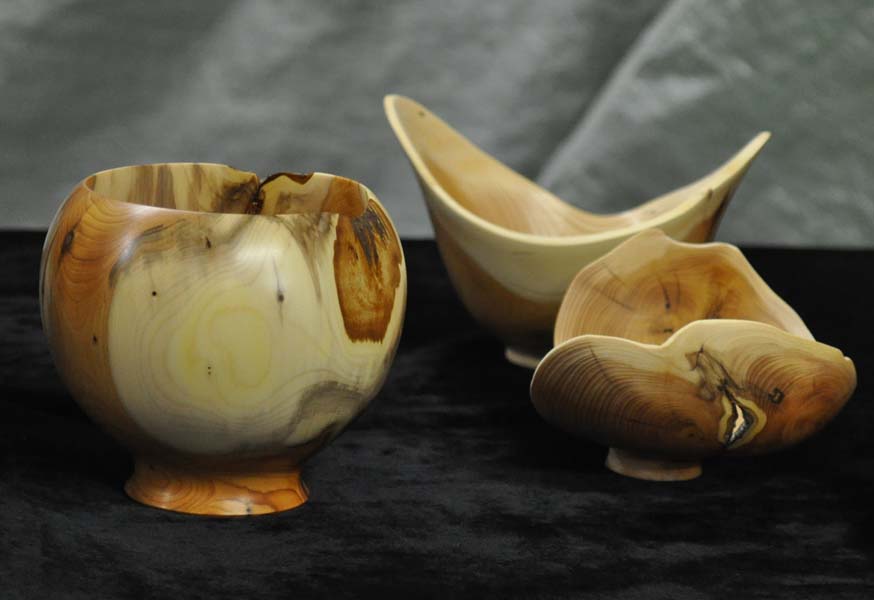
A selection of work Randal brought along on the evening.