Ryedale Woodturners Club Demonstration
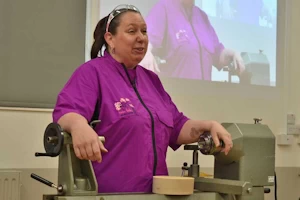
Helen Bailey
Thursday 5 June 2025
Snainton Village Hall
We welcomed Helen Bailey from Newcastle demonstrating for the first time at our club.
Thin walled pierced bowl

Helen strted with a sycamore bowl blank munted on a screw chuck. Sycamore works well for thin walls, as it has close grain and is generally even in texture. She prefers dry wood rather than wet, for stability. A small (38 mm) chucking point was cut into the base, ready for reversing.

The blank was reversed and held in Axminster O'Donnell jaws, which allowed greater access to the base than standard 50 mm jaws, also aided by the sloping design of the jaws. The inside of the bowl was turned away an inch at a time, keeping a core of wood in the centre for as long as possible to provide some stability. Each inch of bowl wall needs to be finished as the turning progresses - it will move slightly and be impossible to return to later.
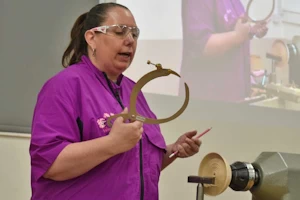
The target wall thickness was 1.5 - 2 mm, tested with some very clever scissor calipers, (available from Pat Carroll). These have a screw on them, and as they test the thickness for any variation, the screw moves back and forward accordingly, showing the thickness. When a bowl is to be pierced, it is important that the wall thickness is uniform.
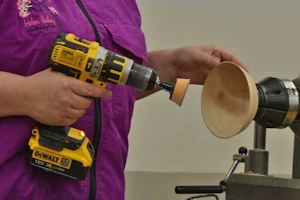
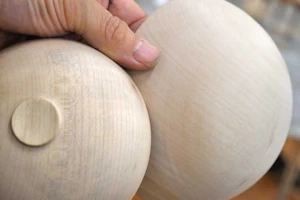
Having shaped the inside of the bowl, with a bowl gouge, it was sanded as it normally would be for any bowl, in preparation for piercing. A decision to be made was whether to leave a foot on the bowl, or whether to take it off and have a perfect bowl shape. Both possibilities have their merits. In this case the foot was left on, tidied up using a jam chuck (during the interval).
Piercing technique
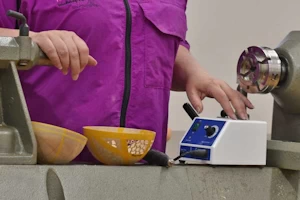
The second half of the demonstration was concerned with piercing. Helen used a Foredom micromotor running at 38,000 rpm, her favoured choice. She initially used a Dremel which runs at 5000 - 35000, with a hanging motor unit connected to the handpiece with a flexidrive shaft. The Foredom has the motor in the handpiece, which compared to the Dremel flexishaft reduces the vibration - important to reduce muscle strain when using for a couple of hours at a time.
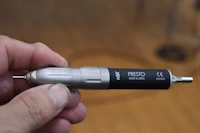
She does have an NSK Presto pneumatic handset (Presto), which runs at 380 000 rpm, but due to the high speed this tends to burn the sides which then require tidying up. These are available from dental suppliers. It is sensible to have a large compressor to run them, as this reduces the noise due to refilling.
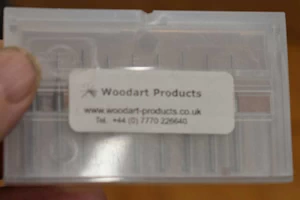
John at Woodart Products makes his own versions of the Foredom kit, running at either 35K or 45K rpm, price £190 / £290. He also sells carbide cutters - £5 each, or a set of 10 for £40. As always with tools you get what you pay for - it is probably best to avoid Lidl in the middle if you are serious about piercing.
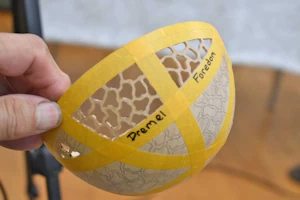


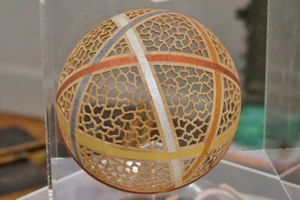
Helen passed round a demonstration piece which showed the difference between the three tools. It also shows areas delineated by thin masking tape, which makes its easier to create straight lines than by drawing. She uses an HB pencil to draw the piercing pattern on to the surface before piercing - some people just go for it, but Helen prefers to have it all mapped out, to avoid awkward boundaries or holes too big or too small.

A variety of files are useful for touching up the piercing, removing any burr around the edges.
Inevitably the piercing part of the demonsration was more talk and examples than creating a finished article. These things can take anything from 40 to 80 hours - impossible to say, because they are done in stages, sometimes well into the night. Key accessories are music, chocolate, biscuits and cups of tea!
Some exhibits by Helen.