Ryedale Woodturners Club Demonstration

Martyn Weller
Thursday 2 May 2024
Snainton Village Hall
We welcomed club member Martyn Weller for a demonstration of different ways to hold items while turning.
Chucks and other things

Martyn explained his purpose during the evening was to show different ways of holding an item on the lathe while turning. To this end, his choice of turning was a simple bangle, which could be varied in design, and could be mounted on the lathe using a variety of methods. A bangle for a woman is usually 65 to 70mm internal diameter.

Pin jaws are an alternative. Very versatile, these can grip small diameters down to the size of a pencil, and grip in expansion mode inside a recess, which can be ceated with something like a 1" Forstner bit. They can also hold something like a bangle in expansion mode on the outer rim of the jaws.
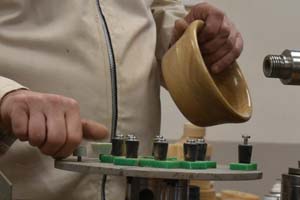

Cole jaws have 4 plates, each with a series of moveable studs screwed into holes, allowing adjustment to required diameters. Mainly used for reversing a bowl, which is held by the rubber studs around its rim, allowing a spigot to be removed and the foot finished. Martyn had adapted his with longer studs (which required the purchase of longer holding screws), each resting on small plastic plates to lift the wood away from the metal and reduce the chance of damaging chisels when turning.

Faceplate rings can be screwed on to a piece of wood, and then held in chuck jaws either by compression or expansion. A spigot could be made in the same way and screwed on for holding. These can be cut from nylon chopping boards which are readily available in supermarkets. They are very strong, cheap, and very versatile.

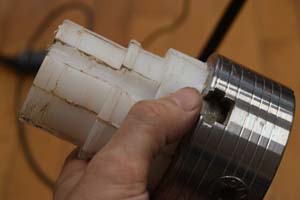
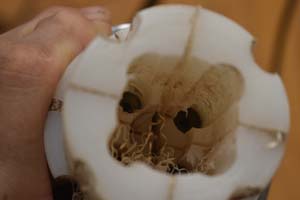
Soft jaws can be purpose made from HDPE (High density polyethylene). These can grip wood without biting into it and leaving marks. For something like a bangle, or a box or vase, they can be used in expansion mode to hold a piece. With the centre cut out, the jaws can contract on smaller, narrow items, such as spheres or eggs. HDPE can be bought as a cylinder in various sizes.
 -
-
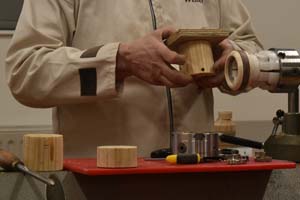
Martyn demonstrated how to make a set of jaws, though using a block of wood rather than HDPE to save on the expense. Dimensions are important. A drilling jig was made to ensure the holes in the jaws would match those in the chuck.

A home-made doughnut chuck allows all kinds of items, regularly and irregularly shaped, whilst turning. One plate is fixed to a chuck, the other is bolted on with coach bolts and wingnuts, and the item to be turned is fixed in between to allow whatever turning is required through the cutaway centre of the chuck.

A wooden jam chuck made to hold a particular piece can be enhanced by making four cuts in the sides, and then placing a jubilee clip around them to provide the compression. This doesn't allow for much adustment in size, but is effective at holding a piece, usually for finishing, without creating the indentations that metal jaws would inflict.
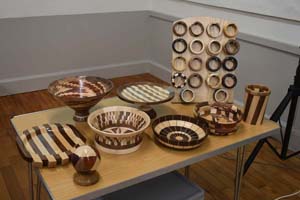
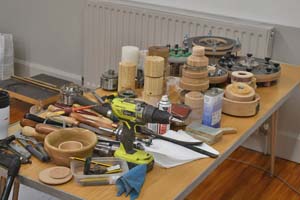
Some exhibits by Martyn.