×
![]()

Ryedale Woodturners

Martyn Weller
Thursday 1 June 2023
Snainton Village Hall
Martyn Weller entertained us royally once again, expounding on the techniques involved in making three different challenging bowl forms.
He started his demonstration with a rendition of a short literary excursion he had written, aided by fellow club member Geoff Walker. The script is available.
Three challenging bowls
Three-cornered bowl
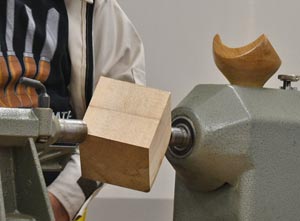
Martyn started with a three cornered bowl. This is achieved by turning a cube held between corners, with one corner held in the headstock spindle, the other by a live tailstock ring centre. Some agressive turning is required, with more air than wood hitting the chisel, until the shape begins to form.
A spigot was created, along with a small foot for the bowl to stand on. The bowl could be left without a foot, but then it is less practical in terms of stability. The foot also lifts the shape from the surface it stands on. It was parted off using a hand saw - it is not sensible to part through with a chisel on an irregular shape with corners, held between centres.


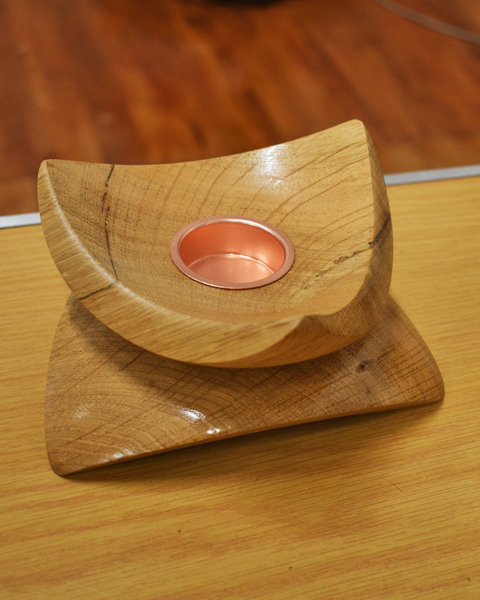
The bowl was then reversed and held on its spigot to allow hollowing out the bowl. Great care is required to avoid catching the spinning corners, either with the chisel or with your hand. The end product can be a simple bowl, or it could have a recess in it to take a tea light. The roughed out bowl was dismounted and passed around for inspection.
Martyn didn't do any sanding on the night, being more concerned with showing us the techniques involved in creating the bowl rather than creating a finished piece. A few versions were available on his gallery table (see below). Sanding does require care because of the corners - a sponge sanding pad wrapped in abrasive paper will soften some of the unevenness; a cushioned hand-held sanding arbor could also work (for example a Hope Pro Sander).

Bowl within a bowl
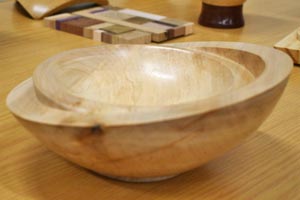
Martyn's second project was to turn a bowl within a bowl, the inside one slightly offset to the outside. This one is in ash, starting from a 10 x 4" blank. In this project, a bowl is turned as normal, but with quite thick walls, so that they could be turned in two halves to create the effect of two bowls.


Conscious of time limitations, Martyn had brought along a bowl he had already turned, in order to move things on, and show the more advanced techniques in preference to basic bowl turning.
To create the offset bowl, the existing bowl was held between two jam chucks. The headstock end was a dish shape, held by a spigot. The tailstock end was a dome, held by a screw threaded live centre (from RDG tools).
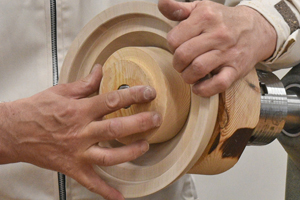

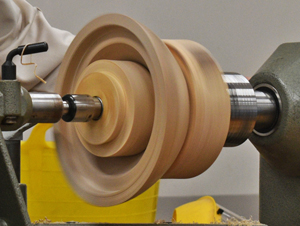
The inner-outer bowl effect was achieved using a carbide tool, gradually cutting or scraping away half the bowl rim until the two bowls were level at one point on the circumference. Once again mindful of time, Martyn didn't do any sanding to a finish, feeling he had done enough to show the techniques involved, to allow members to have a go themselves if so minded.

Square bowl
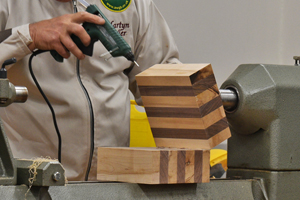
Moving on to his third project, Martyn had glued up some blocks to make two square cuboids - two solid blocks could be used if preferred. These were hot-glued together to hold while turning, to be separated later. Martyn does this using hot air (from a paint stripper or hair dryer for example), or vinegar can be used.
The block began to take shape, but inevitably time was running out, so Martyn explained how the two blocks would become two square bowls, and used the exaples he had brought along to help visualise this.

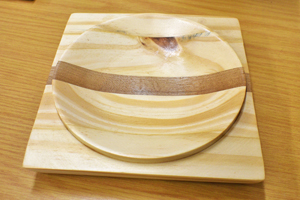
Martyn's exhibits on show at the meeting